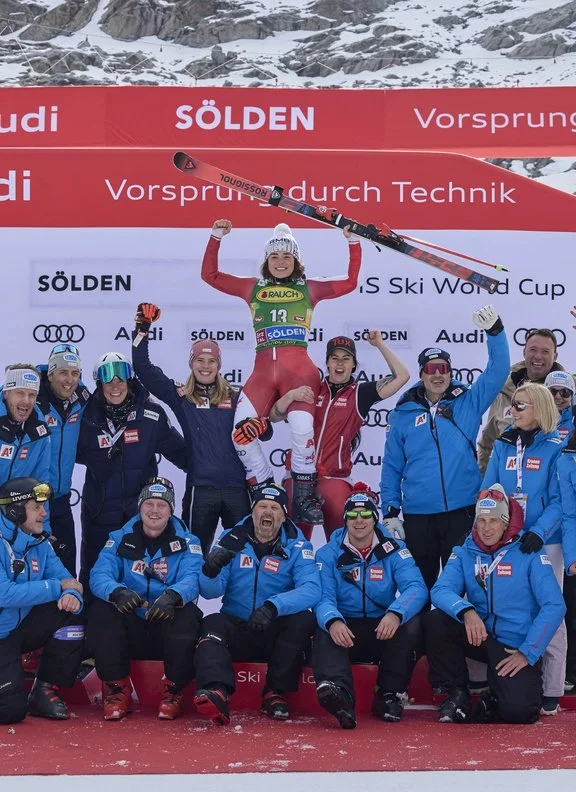
Racing Above the Clouds
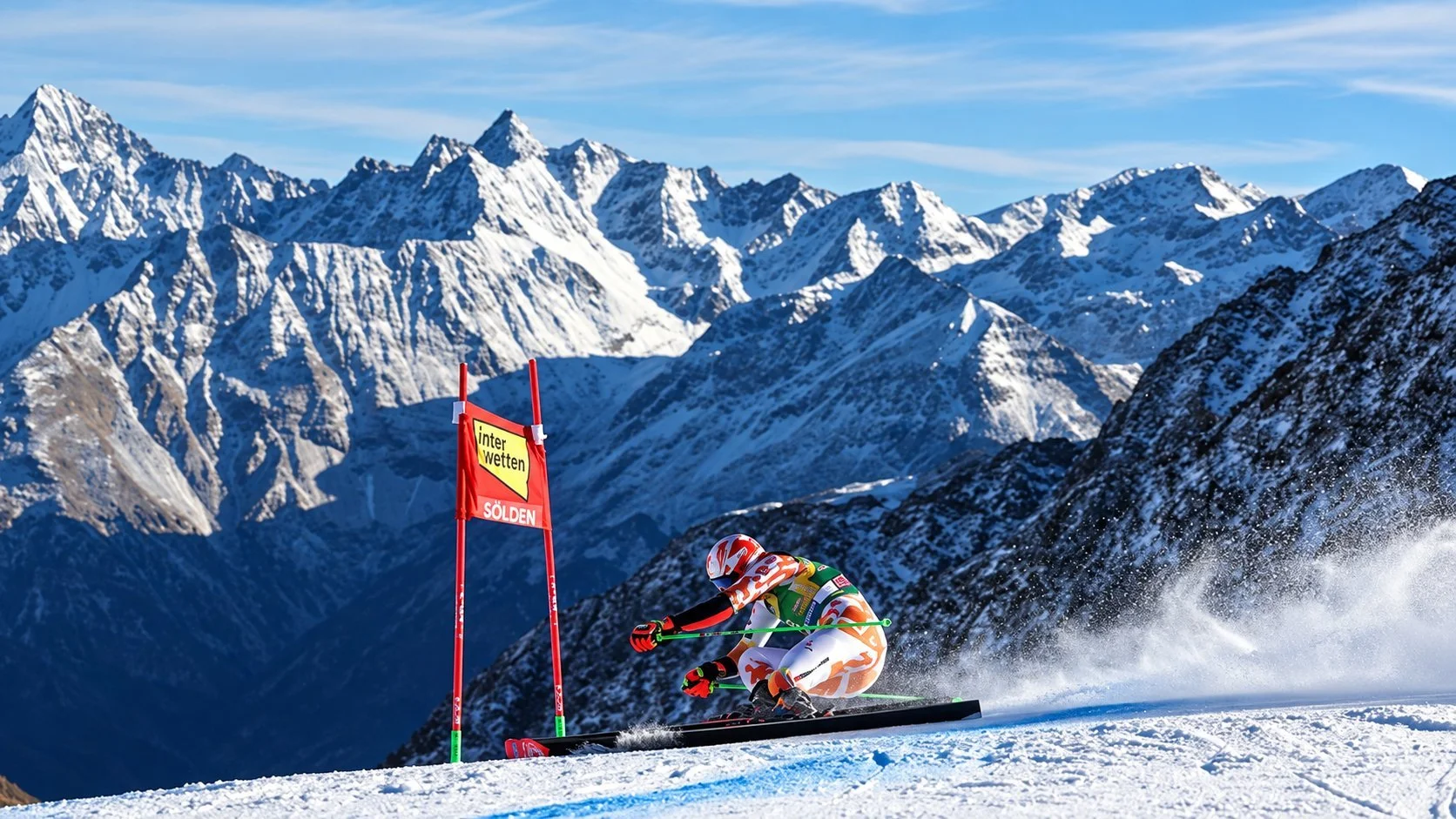
There is a particular moment in the alpine year when winter becomes an intention before it blankets the landscape. The valleys have not yet surrendered their autumn colours. Roads remain dark against the hillsides. In the village, a coat may still be carried over an arm rather than worn. Yet somewhere above, beyond the last trees and the comfortable scale of ordinary life, skis are being prepared, gates planted and a starting house made ready. The season has begun to assemble itself.
In Sölden, that moment has an address: the Rettenbach Glacier. Here, high in Austria’s Ötztal Alps, the opening of the Audi FIS Ski World Cup gives winter its first public appointment. The 2026 women’s and men’s giant slaloms are scheduled for 24 and 25 October respectively. Before the familiar procession of deep-winter races, before the valleys settle beneath snow, the sport returns to this exposed place to ask its oldest question. Who will be the fastest on the mountain?
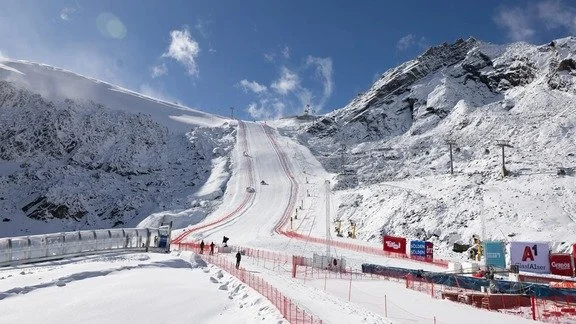
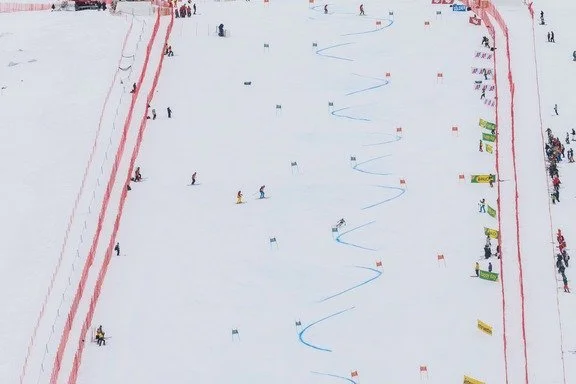
Sölden’s glacier road carries the visitor out of the inhabited valley and into a country of rock, distance and diminishing vegetation. On race weekend, shuttle buses connect the village with the glacier. The ascent compresses the seasons: autumn below, the working landscape of winter above. Looking back toward the valley, one understands how much of skiing’s appeal begins before a ski ever touches snow. At the glacier, the race infrastructure supplies a different sort of scale. Safety nets, cameras, timing equipment and the finish arena impose a temporary geometry upon the mountain. From afar, the course appears almost delicate, a line of coloured gates traced across an enormous white surface. Nearer, its seriousness becomes apparent. The slope is no backdrop. It is the principal participant.
Sölden’s first World Cup races took place in 1993. The event initially returned at intervals before becoming the established annual season-opening fixture in 2000. Its tradition is therefore younger than those of some great alpine racing destinations. There is no need to lend it a borrowed century. A generation of repeated Octobers has given the glacier its own authority.
The appeal of an opening race differs from that of a midwinter classic. Later in the season, reputations have acquired evidence. Form can be measured against recent results; confidence and fatigue have begun their negotiations. In October, the possibilities remain unusually open. Months of preparation exist largely out of sight, in training sessions, physical conditioning and the patient adjustment of equipment. Sölden is where private work first becomes public fact. For the spectator, this creates a pleasure beyond prediction. Familiar names return, but familiarity offers no guarantee. A new season may reveal a changed skier, a recovered rhythm or a competitor suddenly able to do what previously remained just beyond reach. The first race is compelling because everyone, however celebrated, must begin again.
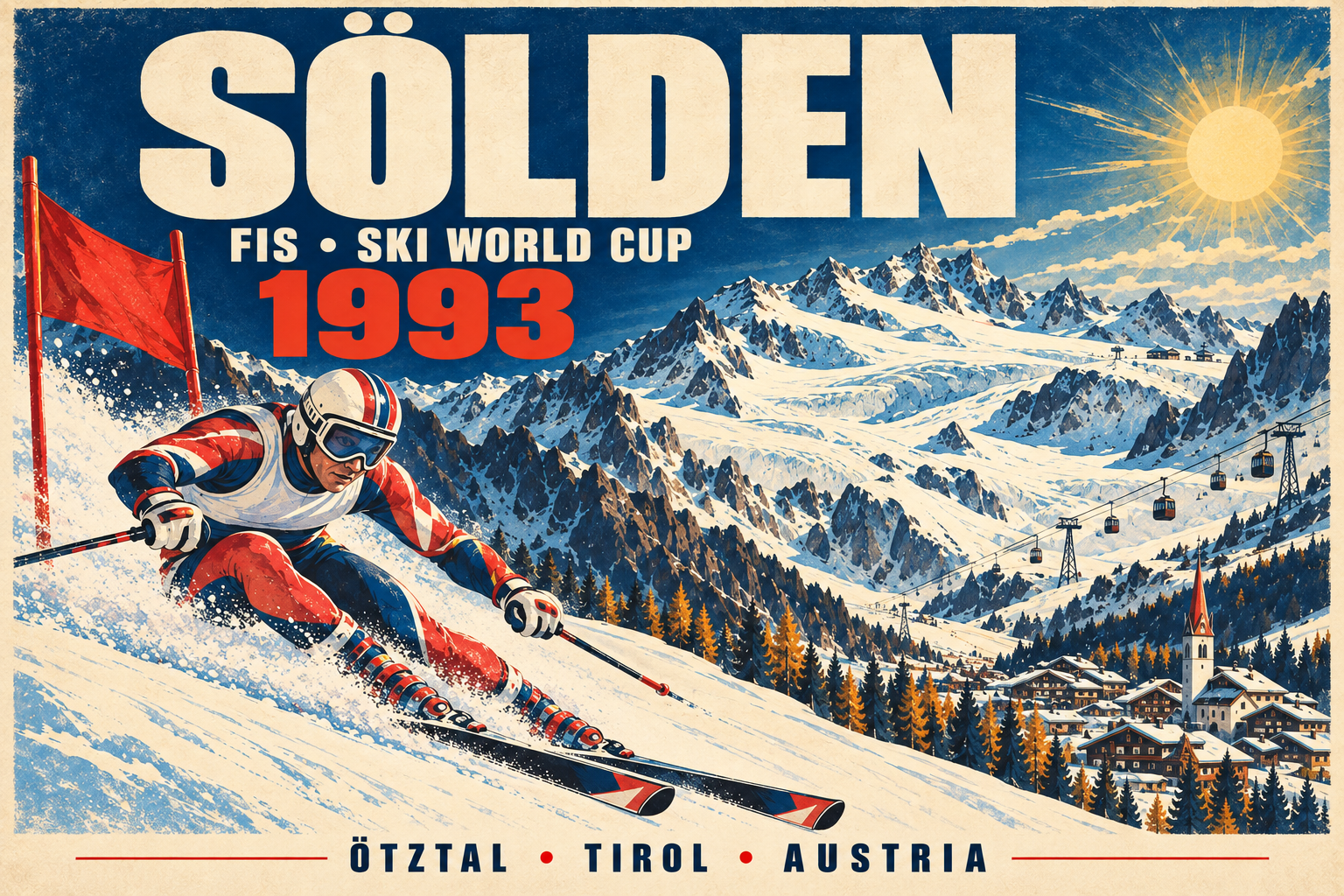
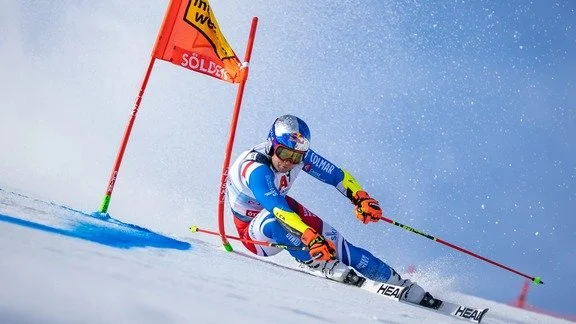
Giant slalom rewards a quality that is difficult to describe without making it sound quieter than it is: continuity. The skier must connect one turn to the next while negotiating speed, pressure and a line that never remains available for long. A successful passage can appear flowing, almost inevitable. Its elegance conceals a succession of urgent decisions. Rettenbach makes that distinction visible. The organizer lists a starting altitude of 3,040 metres and a finish at 2,670 metres, with the steepest section reaching a gradient of approximately 68 per cent. These figures explain the dimensions, but they do not convey the sensation of the course. Its central steep pitch turns rhythm into a demanding physical obligation. A small hesitation can carry forward; a compromised exit from one gate changes the possibilities at the next. The result is a spectacle of proportion. Too much aggression can undo the line. Too little gives time away. The best skiing finds a balance that must be continually renewed, adapting strength to the shape of the slope. Watching from below, one sees flashes of spray, the bend of a ski and the brief disappearance of a racer behind the fall of the terrain. The clock translates those movements into a verdict, but the eye retains something the numbers cannot: the character of a turn.
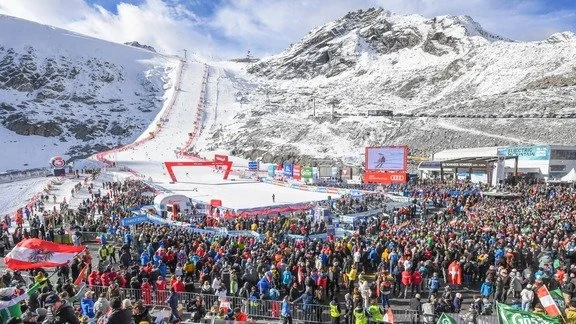
The race also belongs to those who travel upward to watch it. Sölden’s opening weekend gathers a public for whom skiing is a shared language, carrying family allegiances, national loyalties and the recollection of winters spent following the circuit. Flags and fan-club colours make the stadium bright against the snow. A mountain that might otherwise appear remote becomes, briefly, a meeting place. The 2026 programme extends that gathering into the village. The women’s bib draw is scheduled for Friday evening at the Giggijoch valley station. Saturday brings the women’s racing, followed later by a fan-club parade, the women’s award ceremony and the men’s bib draw. The men race on Sunday. The weekend moves between glacier and valley, effort and celebration, the concentration of competition and the sociability that gives it a larger life.
Eventually, the races are run and the crowd descends. The noise of the finish gives way to the quieter activity of departure. In the village, the weekend gathers itself into ordinary pleasures: a warm room, food brought to a table, a coat hung where it can dry. The first results of the season become conversation, and conversation becomes expectation. There will be other races, other mountains, other mornings when the weather is read before breakfast.
What remains distinctive about Sölden is the feeling of having crossed a threshold together. The calendar still says October. Autumn persists somewhere down the valley. Yet the sound of edges on a prepared slope has restored a familiar order to the year. For those whose lives are measured partly in winters, this is a beginning that a date alone could never provide. Long before the deepest snow, the mountain has called its company back. Skis have been set on the start, the first turn committed to, the season entrusted once more to skill and circumstance. Above the clouds, winter is no longer merely approaching. It has found its line.