
An Austrian School in the White Mountains USA

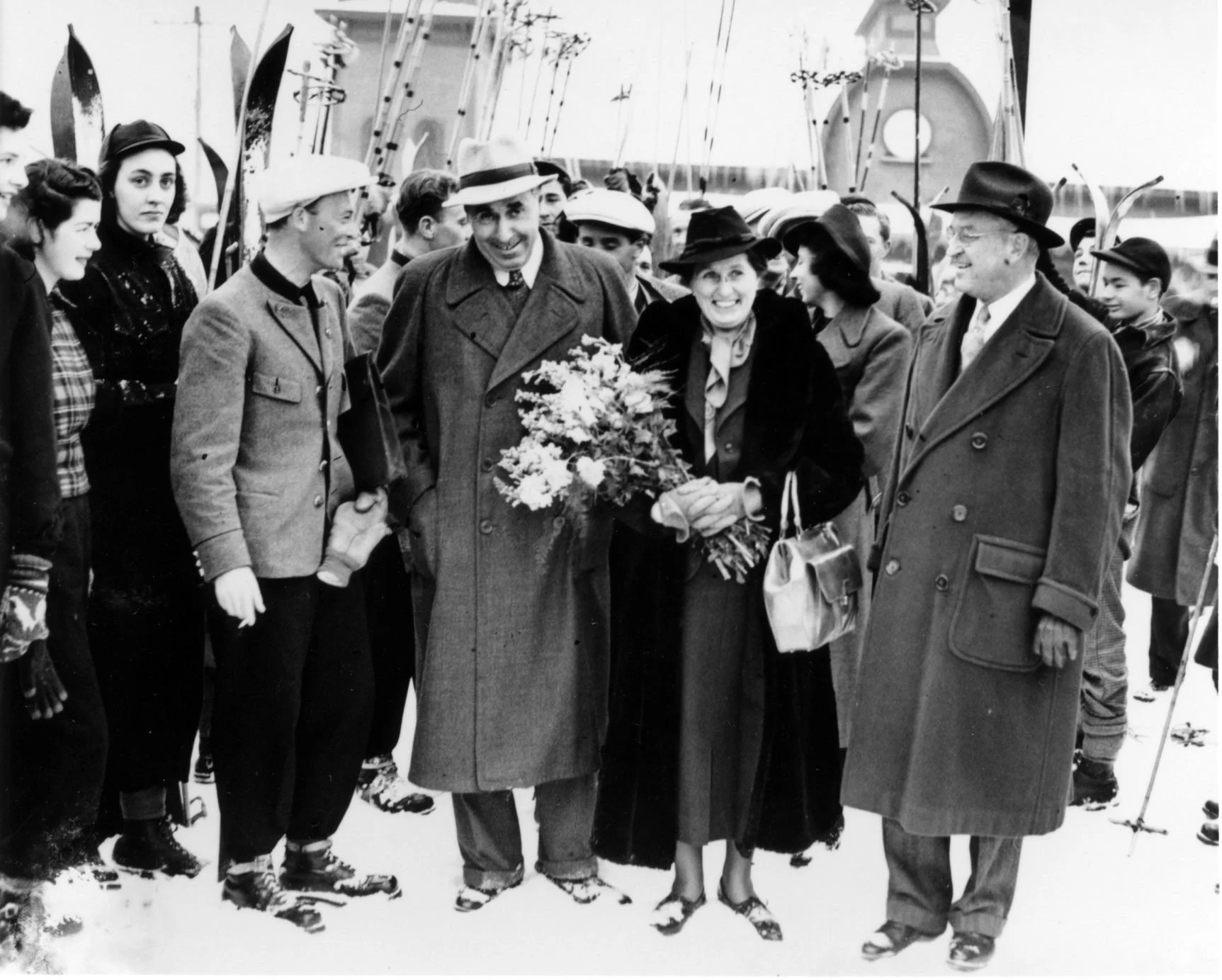
On February 11, 1939, Hannes Schneider and his family arrived in North Conway, New Hampshire, to a welcome made with the tools of their profession. Local skiers raised their poles into an arch. Beneath it passed a man whose teaching had already influenced the way much of the skiing world moved across snow. He had come from Austria by way of persecution and displacement. In this small American town, there was a mountain waiting for him.
The photograph of that arrival has the intimacy of a family occasion. Schneider stands beside his wife, Ludwina, flowers gathered against the winter clothing. Yet the event belonged to a much larger history. An established European ski culture was finding a new home in the White Mountains of New Hampshire USA, carried by people who knew how to teach it. Mt. Cranmore would become one of the places where that inheritance took root.
The school’s beginnings preceded Schneider himself. In 1936, Carroll Reed established a ski school in the Eastern Slope region of New Hampshire and brought over Benno Rybizka from Schneider’s renowned operation in St. Anton. The first winter, 1936–37, placed Austrian instruction within reach of visitors to the local town of Jackson. Rybizka later opened a Cranmore branch, giving the developing mountain an instructional lineage before its most celebrated teacher set foot next door in the town of North Conway.
Reed understood the promise of a sport still taking shape in the American imagination. A winter visitor needed somewhere to stay and equipment to use, but also someone who could turn an unfamiliar slope into an intelligible experience. Rybizka supplied that knowledge. The school made the act of learning part of the destination itself.
The exchange soon ran in both directions. In April 1937, the Eastern Slope Ski Club contributed $200 toward sending four local instructors to St. Anton for training: Arthur Doucette, Arthur Callan, Francis Savard and Tyler Micholeau. The detail is easily lost beside the later celebrity of Schneider. It deserves to remain. A New Hampshire community was investing in its own teachers, sending them abroad to learn a craft they could bring home.
That is the essential foundation of the Mt. Cranmore story. Carroll Reed organized, Benno Rybizka taught, and local people helped build the conditions in which a school could endure. Hannes Schneider’s arrival would give this work extraordinary visibility. Its beginnings were already firmly underfoot.
Harvey Dow Gibson supplied another part of the equation. A North Conway native who became a prominent New York banker, he set out to develop Mt. Cranmore as a winter destination. The mountain opened for the 1937–38 season with a rope tow. Here the ambitions of a financier met the practical intelligence of a ski school: a slope needed skiers, and skiers needed a way to become competent enough to enjoy it.
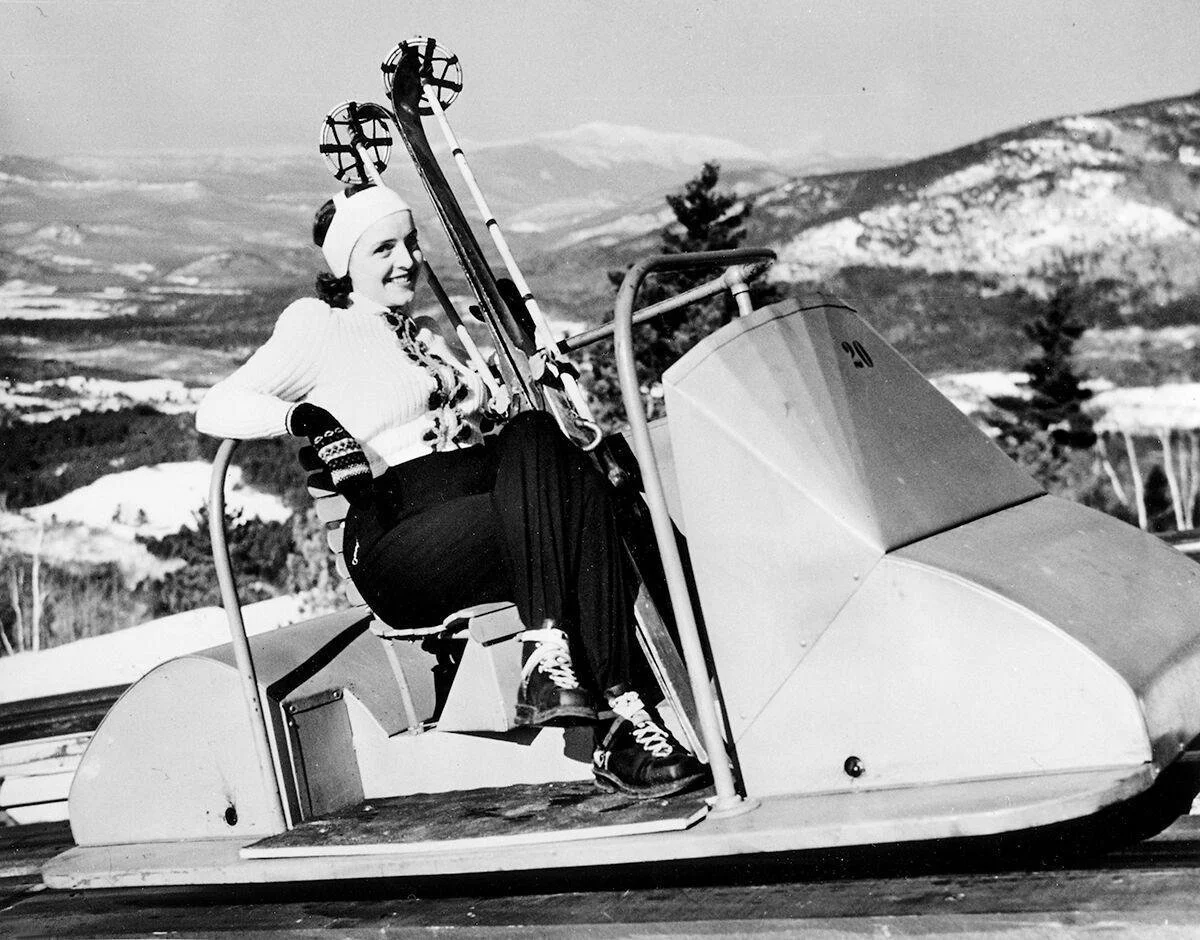
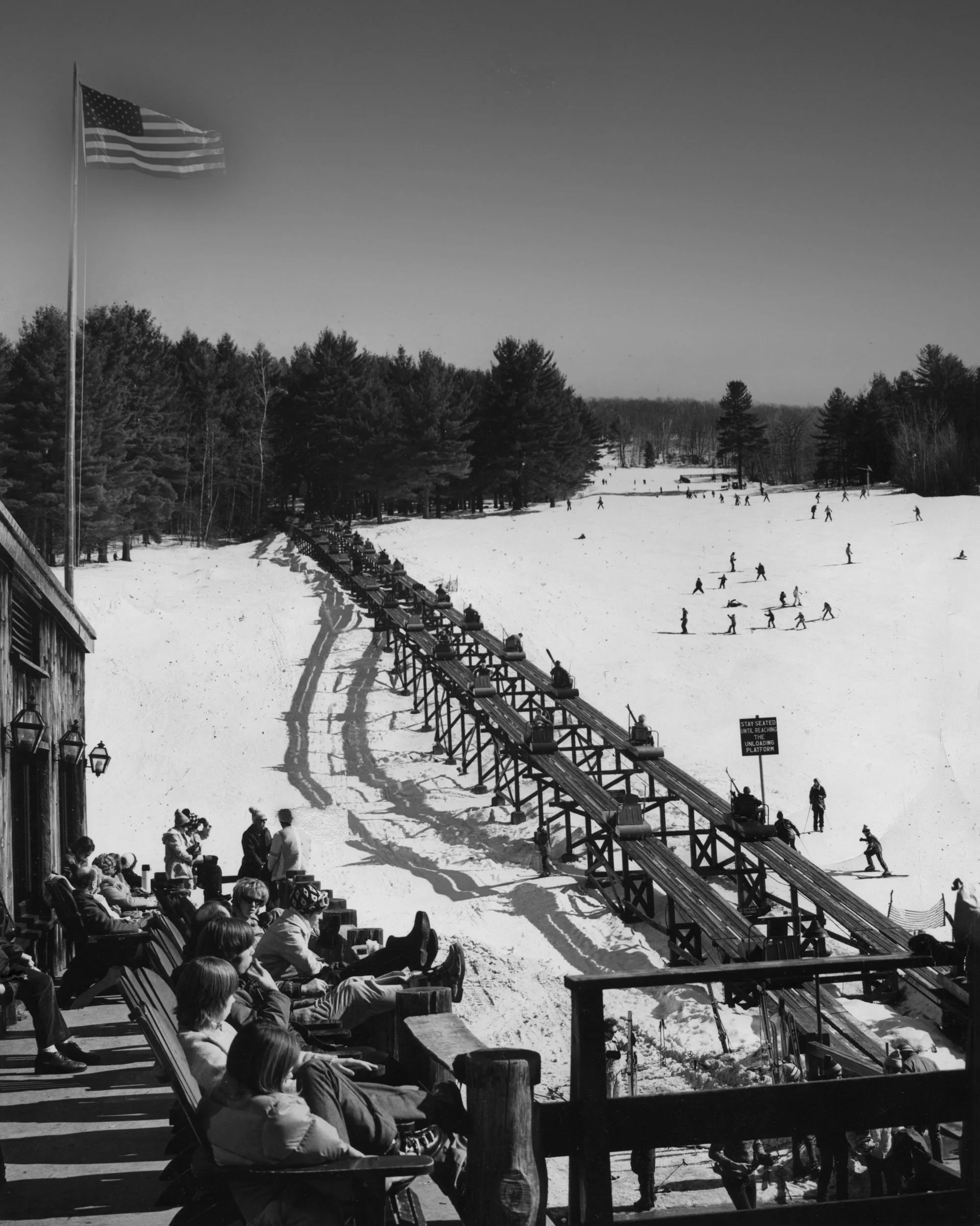
Cranmore’s most memorable piece of machinery followed. Local mechanic George Morton designed the Skimobile, whose small cars travelled up a wooden trestle. Its first stage carried passengers to the mountain’s halfway point; an extension reached the summit in 1939. In photographs it appears almost domestic, a procession of seats climbing patiently through winter. It made ascent part of the mountain’s personality.
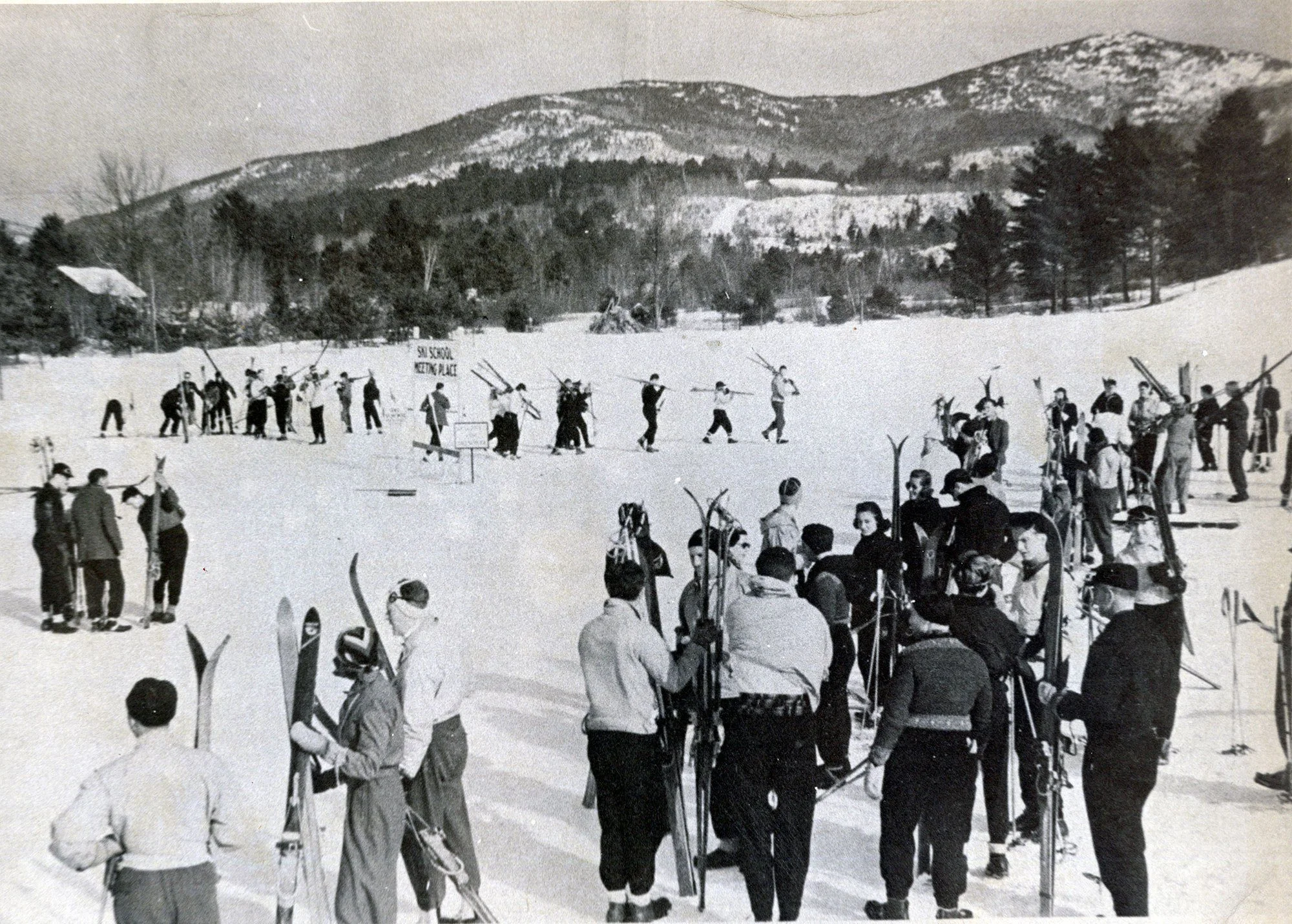
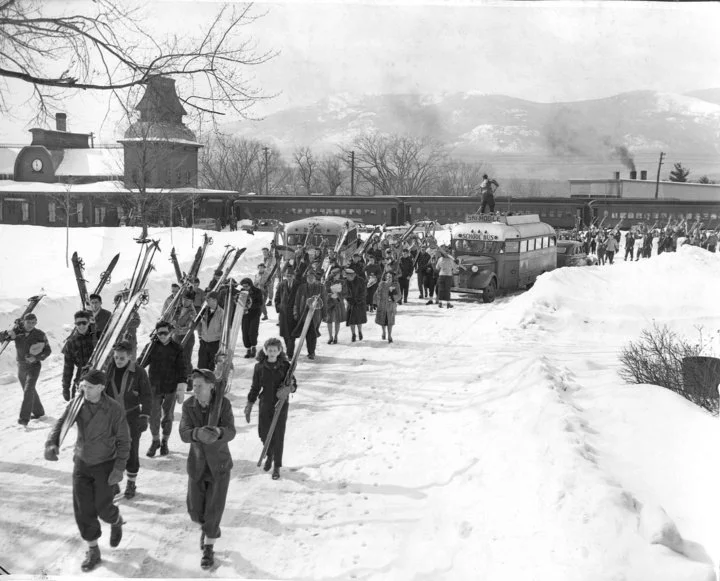
Rail travel gave the valley a wider audience. Snow trains brought city dwellers into North Conway, turning a winter excursion into a shared social experience. The surviving pictures show passengers carrying skis through the snow, their equipment still visibly separate from the body. There is a pleasurable awkwardness to these arrivals. Everyone has brought the means of adventure, though some will need instruction before they can use it.
The school occupied that interval between arrival and confidence. It gave the visitor something to do with the promise of the railway journey and the view uphill. Seen together, train, lift and lesson describe a developing culture of access. The mountain was becoming a place people could enter, learn and return to, season after season.
For Schneider, the journey to New Hampshire was shaped by events far beyond skiing. Following Nazi Germany’s annexation of Austria in March 1938, he was arrested for his anti-Nazi views and subsequently held under house arrest in Germany. Harvey Gibson helped secure his release and the family’s emigration. After crossing the Atlantic aboard the Queen Mary, the Schneiders continued to North Conway. Gibson placed Hannes in charge of the schools he had purchased from Carroll Reed in Jackson and at Cranmore.
It is tempting to tell this as a story in which a famous skier simply changed mountains. Exile gives the move a different gravity. A professional life interrupted by political persecution could continue because another community had room for its knowledge. The welcome at the station acknowledged a celebrated teacher; it also received a family beginning again.
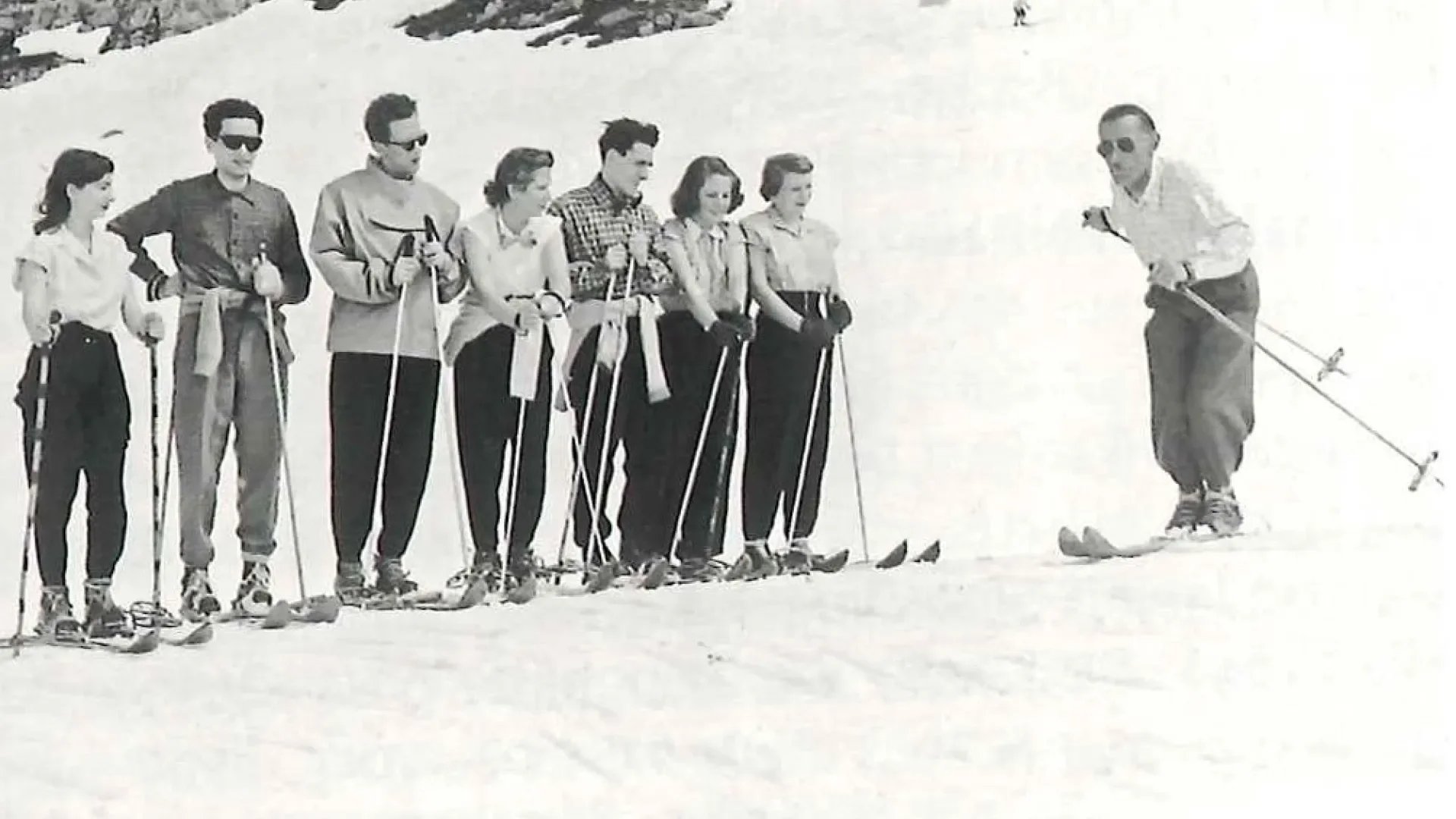
Schneider brought the authority of the famous & traditional Arlberg method. Its importance lay in treating skiing as something that could be taught systematically, with students progressing through recognizable stages toward greater control. The teacher’s task was to make movement understandable and repeatable. For the beginner, that meant a relationship with the mountain based on practice rather than luck.
There is a particular dignity in this kind of instruction. The expert must slow down enough to see what the novice cannot yet feel. A stance, a turn and a moment of hesitation become material for patient attention. At Mt. Cranmore, European prestige found a useful daily occupation in the modest business of helping someone make the next descent.
Benno Rybizka remained essential to this circle. His part in establishing instruction in Jackson and at Mt. Cranmore makes him more than a supporting figure in Schneider’s American chapter. He was among the teachers who had already translated St. Anton’s methods into lessons on New England snow. The continuity between the two places existed in the work of instructors before it could be summarized in a famous name.
Toni Matt also brought a different kind of renown. A young Austrian skier from St. Anton, he came to the United States in 1938 and joined Rybizka’s school. The Hall of Fame’s account of the Mt. Cranmore branch places Matt and fellow Austrian Otto Tschol among its instructors. Matt’s victory in the 1939 Inferno Race on Mount Washington, including his legendary schuss of Tuckerman Ravine’s headwall, made him one of the great figures of American ski lore. His presence gives the school an appealing range. The same world could accommodate the tentative first turn and an audacious racing descent. Teaching and racing drew on related knowledge, even when the speeds and consequences differed enormously. For a pupil, an instructor’s example made the possibilities of the sport visible.
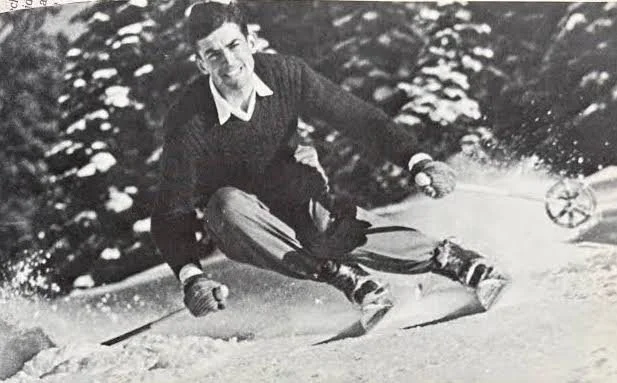
Herbert Schneider carried the school into its next era. After serving with the 10th Mountain Division in World War II and earning a Bronze Star for action in Italy, he returned to teaching. He took over the school following his father’s death in 1955, helped found the Professional Ski Instructors of America in 1961, and purchased Cranmore with partners in 1963. Through Herbert, a family inheritance became a long responsibility to the mountain and its community.
The school’s lasting achievement also belongs to local children. The Eastern Slope Ski Club developed junior instruction and access to equipment as the valley’s ski economy grew. Hannes and Herbert Schneider both supported the opportunity for young residents to learn. A resort could attract visitors from far away while still taking responsibility for the children living below its slopes.
That commitment gives the story its measure. Celebrity may establish a school’s reputation; patient instruction allows a town to make skiing part of ordinary life. The inherited skill must eventually leave the instructor’s demonstration and become the pupil’s own movement. Only then has it truly travelled.
Near the station where the Schneiders were welcomed, the New England Ski Museum preserves Hannes’s boots, a ski and luggage, along with a photograph of the arrival. The annual Hannes Schneider Meister Cup at Mt. Cranmore brings skiing, remembrance and support for the museum together. The objects and the gathering keep different parts of the inheritance in view: a journey, a profession, a community still meeting on snow.
Return finally to those raised poles in February 1939. They formed a temporary architecture, built by skiers to receive a teacher. Beneath them came a family carrying the experience of another mountain world. What followed took years of lessons, winters and local effort. The welcome became something more durable when the people who offered it ultimately made the knowledge their own.